
School Shade Sails: A Procurement Checklist for QLD Schools
Buying shade for a school is not like buying most things a school buys. It is building work. That means approvals, certified engineering, licensed contractors, and a set of documents your certifier will ask for before anything gets installed. It also means working on a site with children on it, around a calendar that does not bend.
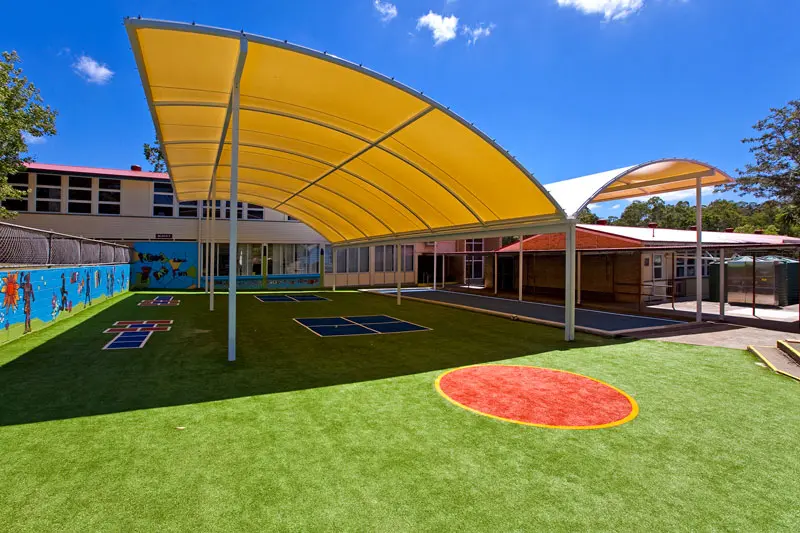
This checklist covers what Queensland schools need to have sorted before going to market, what to ask suppliers for, and how to compare quotes that look similar on price but are not comparable at all. It applies whether you are covering a playground with shade sails or building a full covered outdoor learning area.
1. Scope the project before you go to market
The most common cause of quotes that cannot be compared is a brief that left too much open. Before approaching suppliers, settle:
-
What the space needs to do. Shade only, or shade plus rain cover? A shade sail filters UV but rain passes through. A COLA has a waterproof roof and works year-round. The answer changes the budget by a significant multiple, so decide it first.
-
The area to be covered. Rough dimensions and a site plan if you have one. Note any underground services, existing structures and tree root zones.
-
Who uses the space and when. Lunch area at 11am and 1pm, assembly space on Monday mornings, PE through summer terms. This drives orientation and sizing, because shade in the wrong place at the wrong time of day covers nothing useful.
-
Ground conditions. Rock, fill, reactive clay and proximity to services all affect footing design and cost.
-
Your budget range and funding source. Whether the funding is a P&C contribution, a departmental allocation or a capital works budget affects timing and sometimes the approval path.
If the project is likely to be staged across multiple years, say so upfront. A supplier designing stage one knowing stages two and three are coming will set out the structure differently.
2. Confirm the approvals pathway
School shade structures are building works in Queensland, and commercial structures sit well above the domestic exemption thresholds. In practice, building approval is effectively always required for a school project.
What that means:
-
Building approval is issued by a private building certifier, not by the council directly. You or your supplier engage a certifier.
-
Planning approval may also apply depending on the site, the local planning scheme and the structure.
-
The governing framework is the Planning Act 2016, the Building Act 1975, the Building Regulation 2021, the National Construction Code and the Queensland Development Code.
Ask each supplier who engages the certifier, who pays for certification, and whether approval costs are inside or outside their quoted price. This is one of the most common places quotes diverge.
3. Check certification: Form 15 and Form 12
Two forms matter on a school shade project in Queensland, and they are not the same thing.
Form 15 is the Certificate of Structural Adequacy prescribed under the Queensland Building Regulations 2021. It certifies that the structure is structurally adequate for its intended purpose. It can only be signed by a Registered Professional Engineer of Queensland (RPEQ) holding registration in structural engineering.
Form 12 is issued by the building certifier and relates to classification and compliance with the NCC. In practice, a certifier will commonly require the Form 15 from an RPEQ before they can issue a Form 12.
What to ask for:
-
Confirmation that a Form 15 will be provided, signed by an RPEQ registered in structural engineering
-
Structural calculations and engineering drawings including footing design, wind category, tie-down and bracing
-
Confirmation of the wind region the structure has been designed to, in line with AS/NZS 1170.2
Wind region matters more in Queensland than in most of the country. Sites north of Bundaberg fall into cyclonic wind loading, which changes the steel sizing and footing depth substantially. A quote priced to the wrong wind region will look cheaper and will not pass certification.
4. Verify QBCC licensing
In Queensland, building work valued above $3,300 must be carried out by a contractor licensed with the Queensland Building and Construction Commission. That threshold captures essentially every school shade project.
QBCC has a specific licence class for this work: Builder Restricted to Special Structures (shade sails), which covers construction, installation, maintenance and repair of membrane shade structures including metal brackets, cables and structural members, plus concreting for footings.
Ask every supplier for their QBCC licence number and check it on the QBCC public register before you award. It takes two minutes and it is the single fastest way to filter a tender list.
5. Understand the blue card position
This is where a lot of suppliers give schools incorrect information, so it is worth being precise.
Under Queensland's Blue Card system, in most cases tradespeople entering a school for work do not require a blue card, because the work is not directed toward children and does not permit or facilitate contact with children beyond incidental contact. A plumber fixing a drain or a contractor installing a shade sail generally falls into this category.
A blue card is required where the school operates an education and care service on site, such as outside school hours care (OSHC) or a state-delivered kindergarten program, and the work happens within that service while children are present. The service may occupy an identifiable area of the school or operate across the whole site, so the boundary needs to be confirmed with the school.
What to do:
-
Confirm with your school whether an OSHC or state-delivered kindergarten operates on site and where its boundary sits
-
Ask the supplier how they handle blue card requirements where they apply
-
Check your own sector's policy, because independent and Catholic schools may apply stricter requirements than the legislative minimum
Separately from blue cards, every worker on the site needs a general construction induction training card (the white card). That is a work health and safety requirement, not a child safety one, and the two are sometimes confused.
6. Ask for the right references
Ask each supplier for at least three completed school projects of comparable size and type, with contactable school representatives. Specifically useful:
-
Projects of a similar structure type, not just any shade work
-
Projects in a similar wind region
-
Projects where the supplier managed the approval process end to end
-
At least one project completed more than five years ago, so you can ask how it has held up
A supplier with genuine school experience will hand these over without hesitation. Our school projects across Queensland include Brisbane Boys' College, Sheldon College, Kenmore State School, Redeemer Lutheran College, McGregor High School and Red Hill Special School.
7. Make sure quotes are actually comparable
Shade quotes diverge on inclusions more than on rates. Require every supplier to price the same scope, and have each one state explicitly whether the following are in or out:
-
Design and engineering
-
Form 15 certification and certifier fees
-
Building approval and any planning application costs
-
Site survey and service location
-
Excavation and footings, including rock allowance
-
Access equipment such as scaffolding or elevated work platforms
-
Traffic management or site fencing
-
Removal and disposal of any existing structure
-
Fabric and hardware
-
Installation labour
-
Site clean and reinstatement of turf or paving
-
GST
A quote that excludes footings, approvals and access equipment can look twenty per cent cheaper than one that includes them, and end up costing more.
8. Interrogate the warranty
Warranties on shade structures are not single-term. Ask for the terms separately on:
-
Fabric. Architectural shade fabrics commonly carry a UV guarantee in the 10 to 15 year range. Ask what the guarantee covers, whether it is pro-rata, and what voids it.
-
Steelwork and coatings. Hot-dip galvanised steel and powder-coated finishes carry different terms.
-
Fittings and hardware. Often the shortest term, and usually the first thing to fail on an under-specified structure.
-
Workmanship. Separate from the product warranties and covering the installation itself.
Also ask what maintenance is required to keep each warranty valid. Some fabric guarantees are conditional on periodic cleaning and inspection, which is worth knowing before you sign rather than at claim time.
9. Plan the install around the school calendar
School sites are occupied sites. Build the timing into the brief rather than leaving it to the supplier to raise.
-
Target school holidays for major works, especially anything involving excavation, cranes or elevated work platforms
-
Confirm lead times early. Manufacturing lead time plus approval time usually means a holiday-period install needs to be committed months ahead
-
Agree the term-time protocol for any work that cannot wait, covering site separation, noise-sensitive timing around classes and exams, and access routes that keep students clear of the work zone
-
Check the supplier's insurance covers work on education sites
Our installation crews have worked on Queensland school and childcare sites for almost thirty years. A client at The Gap Child Care Centre noted our team completed the noisy work before children's rest times and worked around the needs of the children on site. That kind of coordination should be a stated expectation in your brief, not a lucky outcome.
10. Plan for the asset, not just the install
The structure will be on your asset register for decades. Before you award:
-
Ask what periodic inspection the supplier recommends and whether they offer it
-
Confirm what a fabric replacement will involve in ten to fifteen years, and whether the frame is designed to accept a replacement fabric
-
Ask for a written condition report format if you manage shade across multiple campuses
Repairs and maintenance on school shade is straightforward when the structure was specified properly and expensive when it was not.
Frequently asked questions
Do school shade sails need building approval in Queensland?
Yes, in effectively all cases. Commercial shade structures sit well above the domestic exemption thresholds, which apply to structures over 10 square metres, over 2.4 metres high, over 5 metres long, attached to a building, or on a commercial site. Building approval in Queensland is issued by a private building certifier rather than by the council directly.
What is a Form 15 and who can sign one?
Form 15 is the Certificate of Structural Adequacy prescribed under the Queensland Building Regulations 2021. It certifies that a structure is structurally adequate for its intended purpose. Only a Registered Professional Engineer of Queensland (RPEQ) holding registration in the structural engineering area of practice can sign a valid Form 15.
Do shade installers need a blue card to work at a Queensland school?
In most cases, no. Queensland's Blue Card guidance states that tradespeople entering a school for work generally do not need a blue card, because the work is not directed toward children and does not facilitate contact beyond incidental contact. A blue card is required where the school operates an education and care service such as OSHC or a state-delivered kindergarten and the work occurs within that service while children are present.
What QBCC licence does a shade sail contractor need?
Building work valued above $3,300 must be carried out by a QBCC-licensed contractor. QBCC has a dedicated licence class, Builder Restricted to Special Structures (shade sails), covering installation, maintenance and repair of membrane shade structures along with footing concreting. Ask for the licence number and verify it on the QBCC public register.
What is the difference between a shade sail and a COLA?
A shade sail filters UV but allows rain through, and is the lower-cost option for covering play areas, seating and walkways. A COLA, or Covered Outdoor Learning Area, is a permanent structure with a waterproof roof, giving the school a space usable in wet weather as well as hot weather. Many schools use both across a campus.
When is the best time to install school shade?
School holidays, wherever the program allows. Because manufacturing lead time and approval time both sit ahead of installation, a holiday-period install usually needs to be committed several months in advance. Where work must happen in term time, agree the site separation and noise protocol with the supplier before work starts.
Getting started
If you are scoping shade for your school and want a supplier who can walk through the approvals, certification and timing before you go to market, we are happy to help. Advanced Shade Systems has designed, engineered and installed school shade sails, COLAs and covered outdoor learning areas across Queensland since 1996.
Call 07 3823 5644 or request a quote and we will visit the site, work through the options against your budget, and provide a fixed-price engineered quote with the certification documentation your approval process needs.
Our Key clients